Everything that keeps a server secure, in one agent.
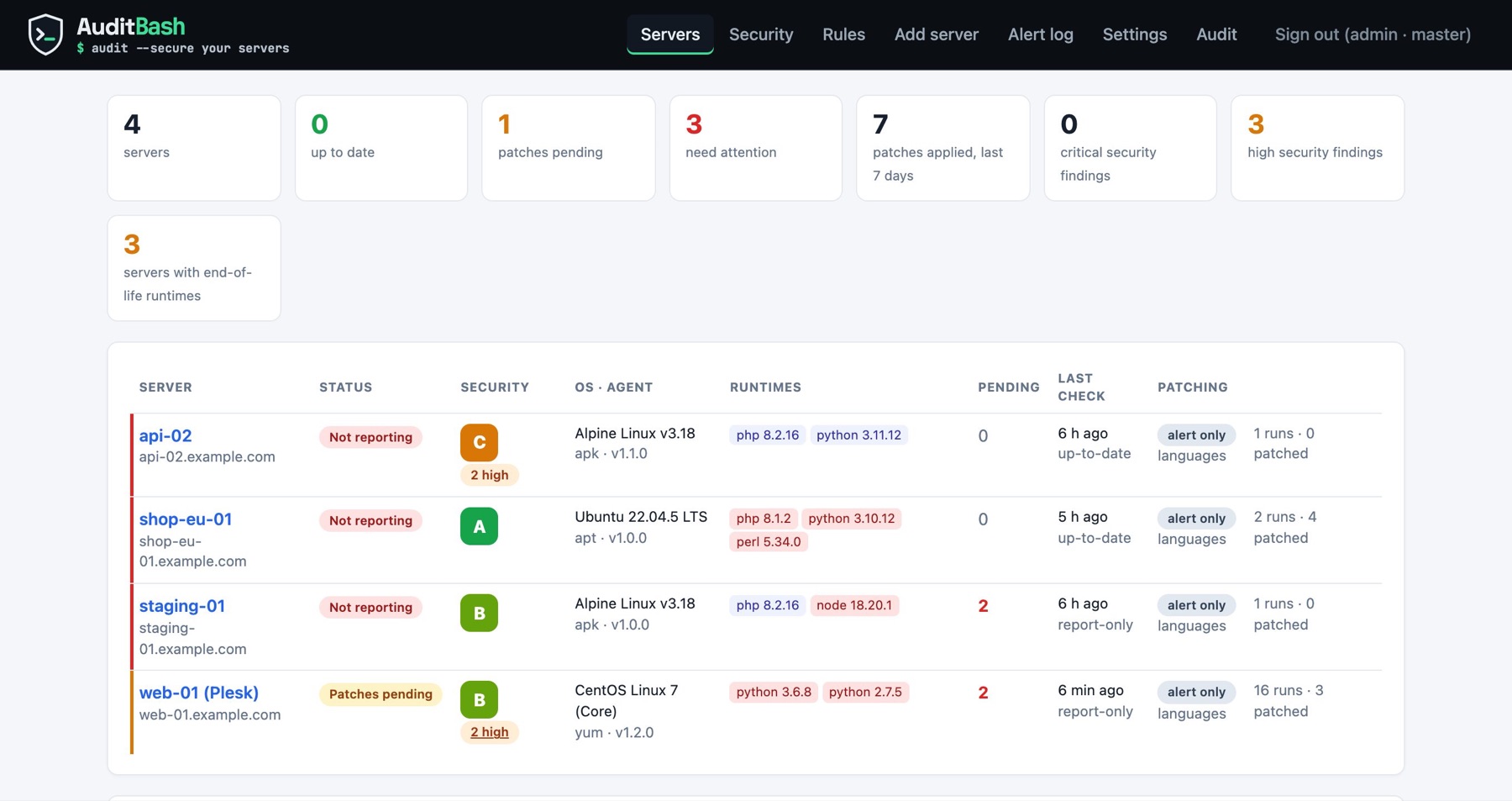
One small script on each server patches it, scans it and blocks attackers. You see every finding and fix it from one dashboard — no terminal needed.
11security scanners
90+security checks
13one-click fixes
2 hpatch & scan cycle
01 · Patching
Security patches, installed while you sleep.
The agent finds which languages and services your server really runs, then asks your package manager for security updates to exactly those — every 2 hours.
Auto-install or alert only. Choose per server: install inside a maintenance window, or just email your team and let them approve.
Safe by default. Versions are saved before every install, PHP-FPM and the web server restart cleanly, and your sites are checked before and after.
Maintenance windows and holds. Pick the hours installs may run, and pin packages you never want touched.
End-of-life warnings. Runtimes and systems that no longer get security fixes are flagged before it is urgent.
02 · Scanning
Eleven scanners. One security grade.
Quick checks on every run and a full scan on a schedule or on demand. Here is everything each scanner looks for.
01
Malware & webshells
Every web root, file by file.
Webshell and backdoor signatures
PHP code hidden inside image files
Obfuscated base64 / hex / chr() code
PHP files inside upload and media folders
.htaccess tricks that run images or redirect visitors
Optional ClamAV deep scan
02
Exposed files
Checked with a real request from outside.
Backups, .zip and .sql dumps anyone can download
.env and config files in the web root
Large piles of CSV / export files
Directory listing switched on
Public Apache /server-status page
03
Ports & firewall
Compared with what was open last time.
Databases and caches open to the internet
New public ports since the last scan
Telnet, r-services and plain FTP
Development ports left open
No active firewall
04
Attacks in progress
Read from your auth and web server logs.
SSH brute force, with the attacker IP
Password guessing on website login pages
Connection floods and SYN floods
Request floods and 404 path scanners
Web attack probes (SQL injection, LFI…)
Every new SSH login
05
Processes
What is actually running right now.
Known crypto-miners and mining commands
Connections to mining-pool ports
Programs running from temp folders
Programs whose file was deleted
Shells and network tools running as the web user
Processes eating the CPU
06
Persistence & accounts
The ways attackers stay in.
Extra root accounts and empty passwords
New users that can log in
New or changed SSH keys
Suspicious cron jobs and systemd services
New setuid programs
ld.so.preload hooks and sudo without a password
07
System integrity
Is the system still what it was installed as?
Core programs that differ from their packages
Core programs changed in the last 24 hours
rkhunter rootkit warnings
08
Hardening
Benchmark-style checks of the server setup.
SSH root login and password login
fail2ban missing, broken or with no jails
End-of-life operating system
Reboot needed, old kernel, disk full, high load
SELinux / AppArmor, NTP, SYN cookies, /tmp noexec
PHP disable_functions, world-writable folders
09
TLS & security headers
Every domain on the server.
Expired or soon-to-expire certificates
Certificates that do not verify
TLS 1.0 / 1.1 still accepted, or no HTTPS
Missing HSTS, nosniff and clickjacking headers
Server and PHP versions shown in headers
10
Mail reputation
So your email keeps arriving.
Server IP listed on spam blacklists
Mail queue suddenly piling up (spam sign)
11
Website health
Checked before and after every patch.
Site down after a patch
Site not responding
Slow responses
One security grade
Every finding has a severity. Together they give each server a score out of 100 and a grade from A to F, so you know where to look first.
ABCDF
CriticalHighMediumLowInfo
03 · Fixing
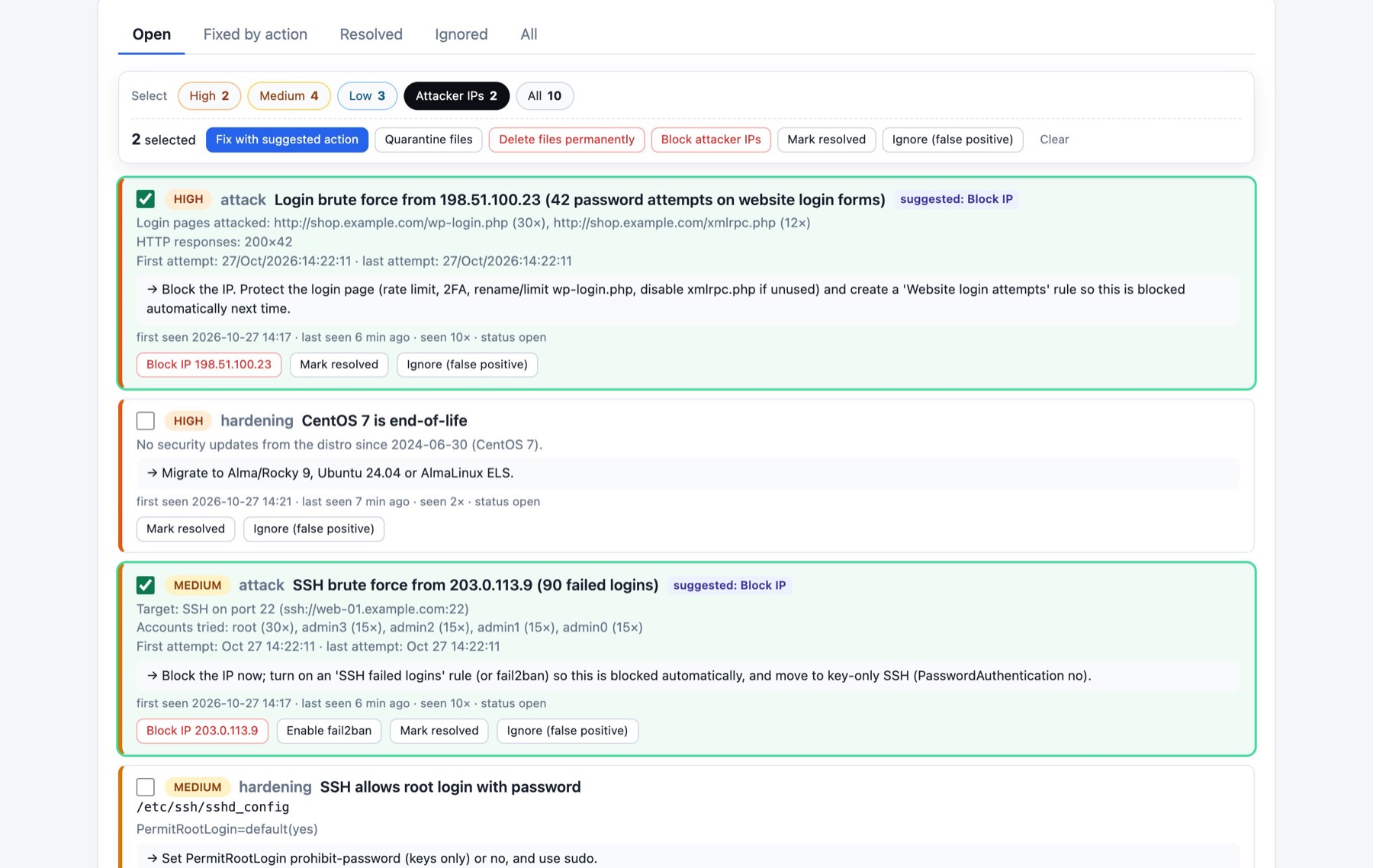
Fix findings without a terminal.
Every finding has the right fix next to it. The agent picks up your action within 2 minutes and reports back what it did.
Bulk fixes. Filter by severity, select all critical findings and fix them in one click.
Clear status. Each finding is Open, Fixed by action, Resolved or Ignored as a false positive.
Guard rails. It will never close your SSH port, block your own IP or delete a config file.
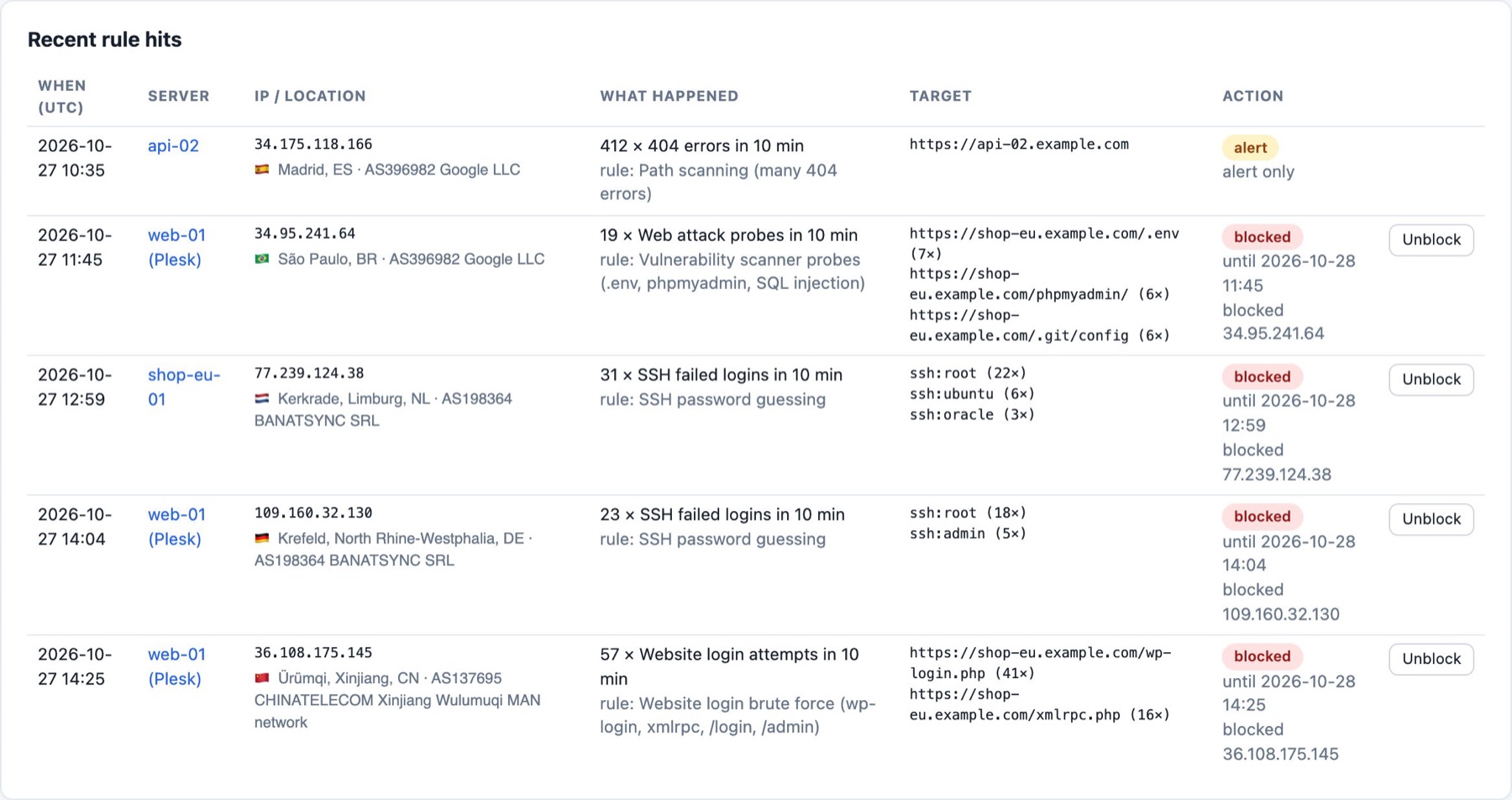
Write rules in plain words: “if one IP makes 10 failed SSH logins within 10 minutes, block it for 24 hours.” Every server checks its logs against your rules every 2 minutes.
SSH and website logins. Counts failed SSH logins and password attempts on pages like wp-login.php, xmlrpc.php, /login and /admin.
Know who is attacking. Each attacker IP is shown with its country, city and network, and the exact page or account it tried.
Your choice of response. Block for a few hours, permanently, or just send an email. Rules start switched off until you turn them on.
05 · Alerts
An email the moment something changes.
Switch each alert on or off and choose who receives them. Nothing to install on your side.
A new critical findingmalware, an exposed secret, a rootkit, a database open to the world
A new high findingobfuscated code, a new public port, an exposed backup, a new SSH key
Attack activityfloods, web attack probes, SSH brute force
Brute-force rule hitswhen a rule blocks an IP or is set to email only
Patches waiting for approvalon alert-only servers or outside the maintenance window
Patches installeda server applied its security updates
A patch failedor the agent reported an error
A site went down after a patchchecked automatically before and after
A reboot is neededto finish installing a patch
End-of-life softwareonce a week per server
A server stops reportingafter the number of hours you choose
A new server finished installingwith its first security report
06 · Dashboard & team
Built like the security tool it is.
Your dashboard holds sensitive data about every server, so it is locked down accordingly.
One-line install
Copy one command from the dashboard. You watch the install and the first scan finish live, step by step.
A page for every server
Overview, Security, Ports, Sites, Actions, Install log and Settings — with the time of the last full scan.
Your own workspace
Your servers, rules, alerts and settings are yours alone. Nobody else can see them.
Team and roles
Invite teammates by email. Admins manage everything, operators fix findings, viewers only read.
Two-factor login
Use any authenticator app. Failed logins lock out, and the login page is never indexed by search engines.
Encrypted at rest
Passwords, tokens and sensitive finding details are AES-256 encrypted in the database.
Audit log
Every login, setting change and remote action, with who did it, when and from where.
Printable reports
A full security report per server, ready to send to a client or keep for compliance.
Never-block list
Your office, VPN and monitoring IPs are never blocked — by a rule or by mistake.
07 · Supported systems
Runs where your servers already are.
One dependency-free bash script. No containers, no inbound ports — the server reports out to your dashboard.